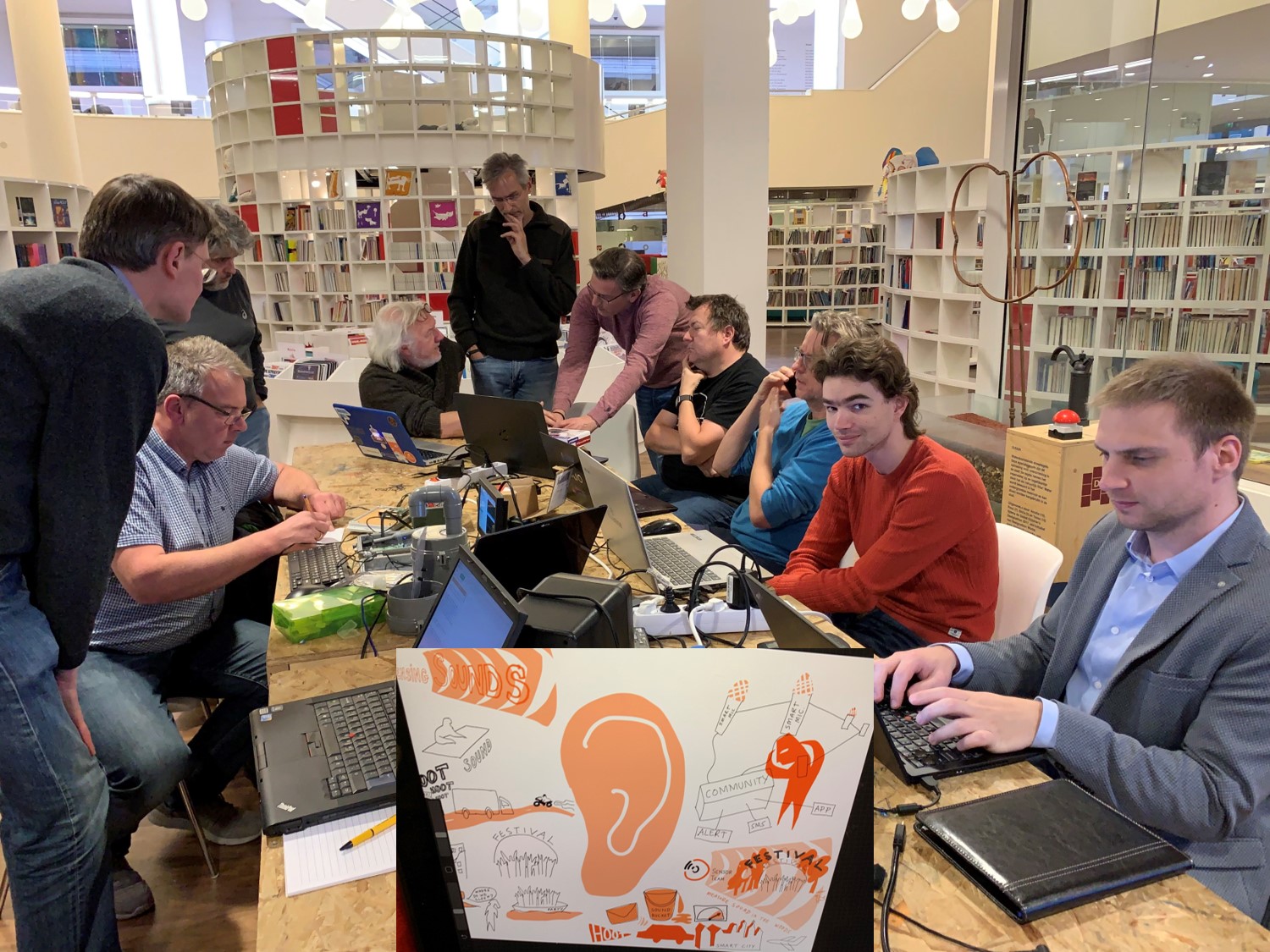
Sound nuisance in the city is a big problem. Sensing and classifying sounds can provide the necessary information to take effective countermeasures in the city “jungle”. Next to this sound sensing can be very relevant in detecting poaching or loose elephants approaching a village in the real jungle. Together with Waag and Sensing Clues SensemakersAMS has been working on a long-running project to classify urban sounds, while at the same time helping Sensing Clues to improve the prototype for use in the outback. Some of the challenges we face(d) from a jungle perspective:
- Energy consumption (RasberryPi) is still way to high, draining batteries way too fast and heating up the device. We want to be as free as possible in device placement (battery powered solution). So, we need to find ways to get power consumption and heat production down.
- Price. We want many devices. At the moment a quite expensive microphone is required, making classification at a greater distance possible.
- Robust design (casing, weather, tamper-proof).
- Various communication options, it the wild we likely need LoRaWan, perhaps even LoRaWan to low orbit satellite. In the cities LoRa (free of charge by TTN, NB-IoT, LTE/M, M2M and perhaps even bursted WiFi are viable options.
- Although a sound classification sensor for the jungle and for the city may differ somewhat in requirements, they can both be worked on. Actually, when the sensor can work in the jungle it certainly will be usable in the city.
Urban Sounds
In the bustling city center of Amsterdam, conflicting interests collide: a vibrant nightlife and noisy traffic coexist in areas where people live and sleep. Noise pollution remains one of the city’s most challenging issues. Until now, Amsterdam has lacked an effective way to measure noise pollution and address its sources.
This problem, highlighted by the Ombudsman of Amsterdam in 2018, led to the launch of the UrbanSounds project. Funded by the City Council, the project aimed to develop an AI model capable of classifying sounds in an urban environment, such as cars, live music, shouting and car horns.
The first AI model was deployed in 2020 at the Marineterrein in Amsterdam. Collaborating with partners like SensingClues and Waag Society, we developed a privacy-friendly solution: a Raspberry Pi with an attached microphone, running a local machine learning model. See figure 1.
We ensure privacy of the passersby by running the model on the device itself. Only the classification results are sent to our secure data storage in a SURF-hosted database.
Improving the AI model
Since the initial launch, we’ve released three versions of the AI model, each improving in quality. The first version used supervised learning with audio samples from Amsterdam’s streets collected by us. The second version, developed by an MSc student from TU Delft, enhanced both the dataset and the model. The current third version employs CLAP, an open source pre-trained model. CLAP’s model architecture is based on semantic search and the model is trained on a much larger, more diverse dataset. This allows us to classify a wider range of sounds, including church bells, birds, cars, helicopters, music etc. etc.
While the model performs well, audio quality can be affected by wind and rain. Since the sensor is mounted on a rooftop, winds of 4 Beaufort or higher sometimes interfere with accurate sound classification. Under calm conditions, however, the model delivers excellent results.
The classified data is sent to a database and visualized using a Grafana dashboard, which is currently offline due to a fire at the sensor’s previous location.
Future improvements include relocating the sensor, refining the model, and enhancing data analysis options. As new and better models emerge, we may also explore integrating those into our system. At the moment (2025/2026) we’re also collaborating with The Green Mile and https://www.tapp.nl/ to expand the number of sensors.
Links:
Github: https://www.github.com/sensemakersams/urbansounds2025
CLAP model: https://huggingface.co/laion/larger_clap_general
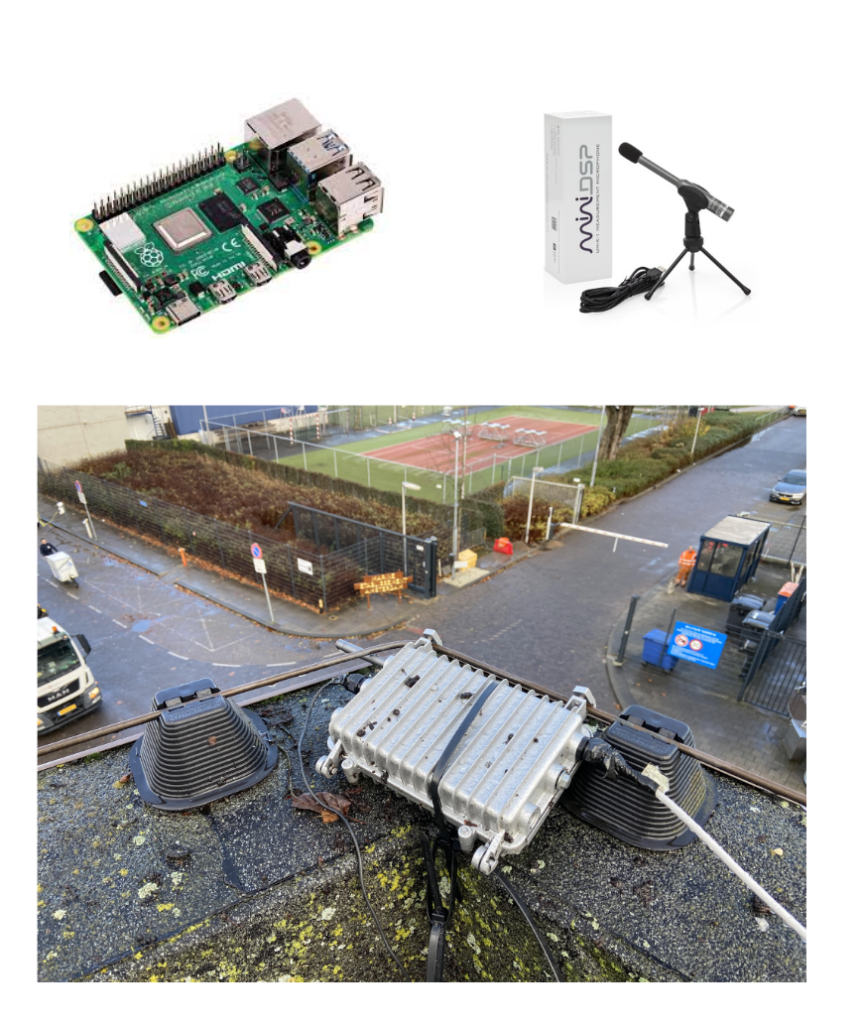
Figure 1: Our setup: a Raspberry Pi 5, a UMIK microphone and a casing, The location is on the roof of the entrance building of the Marineterrein.